No one should have to be brave just to go to work
The women Kajsa Johansson met in Afghanistan do not want to be reduced to victims. They are not powerless, but they live with unreasonable restrictions.
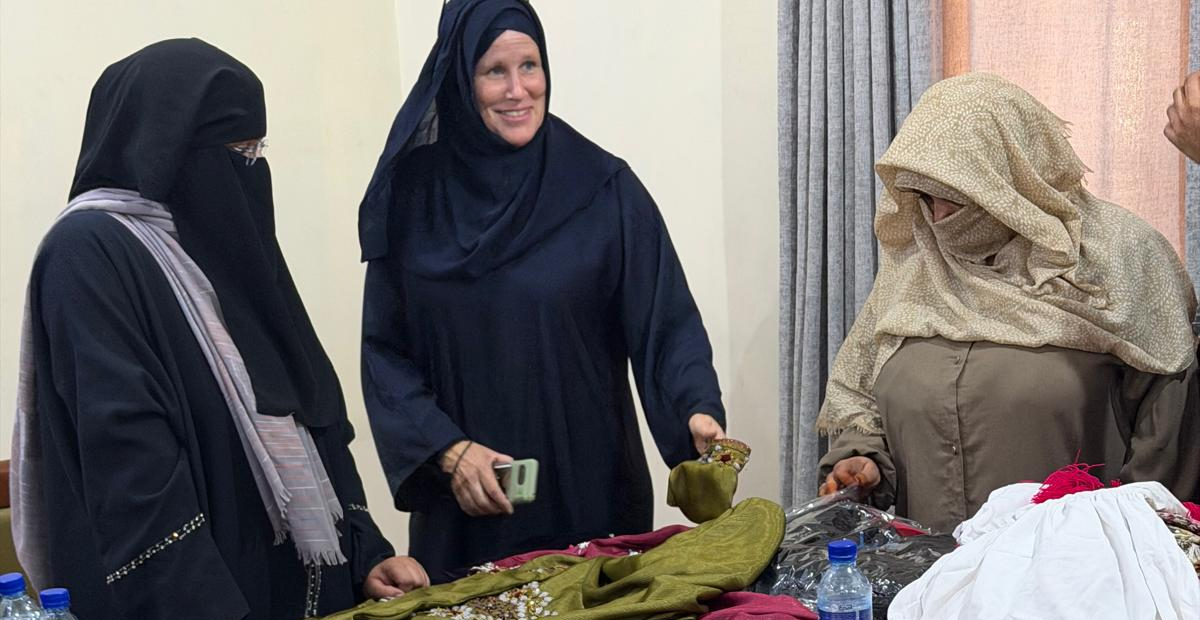
I often find myself thinking how brave they are – the women we meet in Afghanistan who continue to work, run businesses, practise journalism, organise and create opportunities for other women. In our conversations, I want to tell them just that: that they are brave, that they are heroes. And yet, something about those words troubles me. It is completely unreasonable that anyone should have to be brave simply to go to work.
During our most recent trip, we met women in Kabul and Kandahar. Their stories and circumstances differ, but much of what they describe comes back to the same thing: finding ways around the obstacles – some of them as large as mountains – that have been placed in their path. A journalist in Kabul told us how she had been forced to step back from certain parts of her work because, as a woman, she can no longer move freely, meet whomever she wants or access the information she needs. But she has not stopped being a journalist.
In Kandahar, we met a group of women entrepreneurs. It was striking how different their circumstances could be, even within the same city. Some were able to run their businesses relatively openly, with many female employees, while others encountered resistance. One woman told us that she had not been allowed to put up a sign outside her business. So instead, she printed large numbers of business cards and made sure they were widely distributed. Others described how Instagram, WhatsApp, Facebook and TikTok had become essential for reaching customers. Most had men who supported their businesses by purchasing goods, arranging transport and taking care of other tasks where women’s ability to act is restricted.
Find exceptions
It is easy to be fascinated by their ingenuity and persistence, but here too, something troubles me. All these solutions are precisely that: ways of getting around the obstacles – around the mountains. The women, often together with their husbands, find an exception, an opening or a small space that still exists, but that does not mean that the underlying structures are changing. In other contexts, we have talked about the need to identify cracks in the system and try to widen them, so that exceptions might eventually contribute to more lasting change. But when the women are asked how this might happen, answers are much harder to find.
And yet, I believe we have to recognise the significance of these everyday acts. Continuing to open the door to your business in the morning, printing business cards when you are forbidden to put up a sign, employing one more woman or continuing to call yourself a journalist. One of the women entrepreneurs in Kandahar had planned to become a doctor but was unable to continue her studies after the Taliban banned women from higher education in 2022. Instead, she has built a business and created new goals and dreams for herself. At the same time, she still hopes that one day she will become a doctor. Her business is what gives her hope and strength. It is not the structural change Afghanistan needs, but it is a refusal to disappear.
The women we meet do not want to be reduced to victims. Their message is clear: do not look only at what has been taken away from us; look also at what we are actually doing and what we are capable of. This creates a difficult balance for us. While describing the oppression women face, we must not fall into the trap of portraying women as powerless. We need to recognise their agency without romanticising it. The story of brave Afghan women and their extraordinary ability to find ways forward must never become a reason for the outside world to conclude that the situation is, after all, somehow manageable. The fact that people learn to live with unreasonable restrictions does not make those restrictions any less unreasonable.
Exhaustion
Perhaps this contradiction became clearest when we asked the women in Kabul what could change the situation and what they thought the outside world should do. One of them replied: “I no longer have any advice or suggestions. I have given so much advice and so many suggestions, and I don’t know what to say anymore.”
There is a sense of hopelessness in that answer, but also an exhaustion from constantly being expected to come up with new solutions to a situation that these women did not create. This is a balance that we at the Solidarity Committee also need to navigate, both in our work to support women in Afghanistan and in how we describe their situation. Women should not have to be heroes, but nor are they victims. We need to convey both the oppression and the agency, both the hopelessness and the stubborn refusal to give up. And perhaps most importantly, we must not allow women’s ability to keep going to become an excuse for the rest of us to grow accustomed to what should never have become normal.
KAJSA JOHANSSON