Speech: Afghans caught between restrictions and isolation
Afghan women are not only hit hard by restrictions, but also struggle daily to build a future. This was highlighted by Rangina Hamidi during a roundtable discussion.
The speech is presented below.
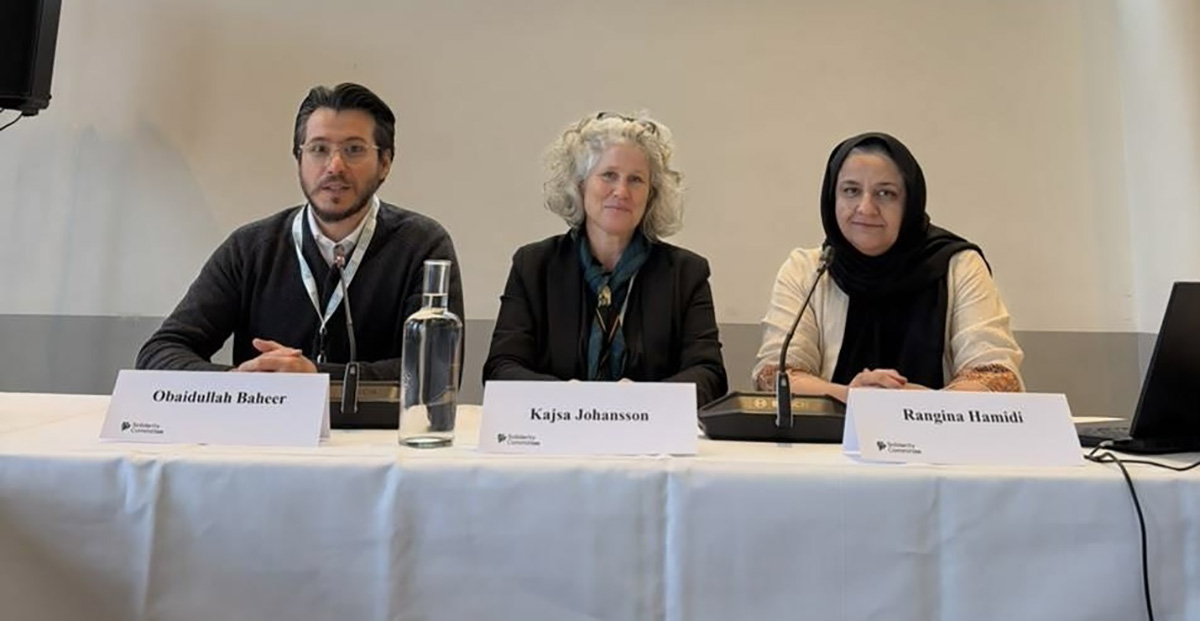
In the beginning of November, the Solidarity Committee for Afghanistan hosted a roundtable discussion entitled Engaging with estranged states – the case of Afghanistan as part of SIPRI ”Stockholm Forum on Peace and Development”. The Solidarity Committee roundtable was the only event throughout the entire forum dedicated to Afghanistan.
Every day, Solidarity Committee work to put Afghanistan back on the international agenda and to amplify Afghan voices. It is more important than ever to continue drawing attention to the people of Afghanistan and the situation in the country.
The report Impact of Sanctions, International Isolation and Aid Conditionality on Afghanistan, together with the accompanying policy brief, were both launched at the event, where the author of the report, Obaidullah Baheer, also particpated.
Read more:
Sanctions and isolation affect the Afghan people
Rangina Hamidi´s statement
Rangina Hamidi is business leader for ‘Kandahar Treasure’, based in Kandahar
As someone who was born in Kandahar to a Pashtun family, who has lived through war, displacement, reconstruction, and more recently Afghanistan’s growing isolation from the world, I would like to begin by reframing how we think about Afghanistan today.
Before we discuss sanctions, engagement, or policy frameworks, I invite us to remember that Afghanistan is not simply a conflict, a policy problem, or a geopolitical puzzle to be solved. It is the birthplace of Rumi, whose words about love, dignity, and human connection continue to resonate across cultures and centuries. It is a land that nurtured scholars, poets, mystics, traders, and thinkers who helped shape the intellectual and spiritual history of our world. It is one of the historic centers of Sufi thought, a tradition rooted in compassion, humility, and the search for meaning. So, when we speak about Afghanistan today, we should not allow four decades of war to erase thousands of years of civilization.
Too often, discussions about Afghanistan begin and end with the Taliban – especially since 2021. Yet Afghanistan is more than its rulers. It is home to more than 40 million people today: farmers, teachers, entrepreneurs, artisans, students, mothers, and young people trying to build meaningful lives under extraordinarily difficult circumstances.
Five years after the Taliban’s return to power, Afghanistan has largely disappeared from international headlines or the attention that it does get is a picture of doom, gloom, and suffocation. But for Afghans, the crisis did not end when the world looked away. It simply changed form.
Today, many Afghans find themselves caught between two forms of exclusion. On the one side are domestic restrictions that limit participation, opportunity, education, and rights. On the other side is an international system that has increasingly isolated Afghanistan politically, financially, and economically. Ordinary Afghans have little control over either, yet they bear the burden of both.
As we discuss engagement today, I hope we can separate our views of the Taliban from our responsibilities to the Afghan people.
Greatest misconceptions
One of the greatest misconceptions about Afghanistan is that Afghans, particularly women, are merely victims waiting to be rescued. That is not the Afghanistan I know, and the brave women actively engaged with Kandahar Treasure in Kandahar remind me of their agency daily when they show up to continue doing what they have been doing to better their lives with dignity since 2003!
Bibi Zainab, Gul Sika, Zia Jaan, Karima, Salma and hundreds of women show up every day to work, learn, produce and contribute, despite restrictions. Let me share the story of one woman, Khadija. She is a young mother of five whose husband was left with a disability after being caught in a suicide attack during the Republic era. Today, through her work with Kandahar Treasure, Khadija is building her family’s own home with the income she earns – one room at a time.
But what stays with me most is what she says about her sons. She wants them to grow up watching their mother work, earn, make decisions and help build their future. She believes that if her boys grow up seeing their mother as a leader in their family, they will learn to see women and girls differently.
And that is why women’s economic participation is about so much more than income. Women like Khadija are not only building homes and supporting families. They are quietly reshaping social norms inside those homes and raising a generation that may see women’s place in society differently.
Investment in Afghan women
This is what investment in Afghan women can make possible.
Across the country, women continue to support families, run small businesses, preserve cultural traditions, educate children, and sustain communities despite enormous constraints. Their resilience is extraordinary. But resilience should not be mistaken for infinite endurance.
The tragedy in Afghanistan is not only that women are excluded. It is that the country is sidelining some of its most capable educators, entrepreneurs, and leaders. Afghan women are not simply the subject of this crisis. They are essential to any solution.
This is why I believe we must honestly assess the consequences of current international policies. We should ask ourselves difficult questions. Have isolation and financial restrictions improved the lives of Afghan women? Have they expanded opportunities for education and livelihoods? Have they strengthened the communities we seek to support?
If our goal is to protect rights and improve lives, then we must be willing to evaluate policies by their outcomes, not simply by their intentions.
Engagement a responsibility
Engagement should not be viewed as endorsement. It should be viewed as a responsibility. The purpose of engagement is not to legitimize governments. The purpose of engagement is to ensure that people are not abandoned.
I have spent much of my life moving between worlds, from Afghanistan to refugee communities, from social enterprise to public service, from Afghanistan to the international community. One lesson has remained constant: people thrive when they are given opportunities, not when they are left in isolation.
Afghanistan’s greatest resource is not its strategic location, its minerals, or its geopolitical significance. Its greatest resource is its people. Any conversation about Afghanistan’s future that loses sight of the Afghan people, especially its women and youth, is unlikely to lead us toward sustainable peace, stability, or development.
The Afghan people cannot be expected to carry the burden of both domestic restrictions and international disengagement. Disengagement has communicated principles, but it has not delivered results for Afghans, especially Afghan women.
I want us to leave with the following three reminders:
1. Afghans Experience International Policies as Daily Realities, Not Policy Debates
- We often discuss Afghanistan through the lenses of security, diplomacy, recognition, and sanctions. Afghans experience these issues very differently. They experience them as an inability to access banks, expand businesses, hire workers, educate children, or plan for the future.
- A sanction imposed in Brussels or Washington may appear technical. In Kandahar, Herat, or Mazar, it can mean a woman-owned enterprise cannot access markets, payments, or capital.
2. Afghan Women Are Not Waiting to Be Saved
- The dominant narrative portrays Afghan women as victims. Certainly, women face enormous restrictions.
- Even under extraordinary constraints, women continue to generate income, preserve skills, support communities, and create opportunities for others.
- The international community should stop viewing Afghan women solely through a humanitarian lens and start viewing them as economic actors and partners.
3. Economic Suffocation Does Not Create Social Progress
- Many assumptions behind international isolation deserve re-examination. If the goal is to improve conditions for women and ordinary Afghans, we must honestly assess whether current approaches are producing those outcomes.
- Economic collapse rarely empowers citizens. It weakens communities, erodes resilience, and increases dependency.
- When livelihoods disappear, families become more vulnerable, not less.
Closing
The question before us is not whether we agree with the Taliban. We do not. The question is whether our policies are helping the Afghan people. If we are serious about supporting Afghan women, protecting livelihoods, and preserving hope for the next generation, then engagement must be judged not by how strongly it expresses our values, but by how effectively it improves people’s lives.