Principled pragmatism is required –for the sake of the Afghan people
The international community needs to distinguish between different ways of engaging with Afghanistan. Failing to engage has disproportionately severe consequences for the population, writes Mark Bowden.
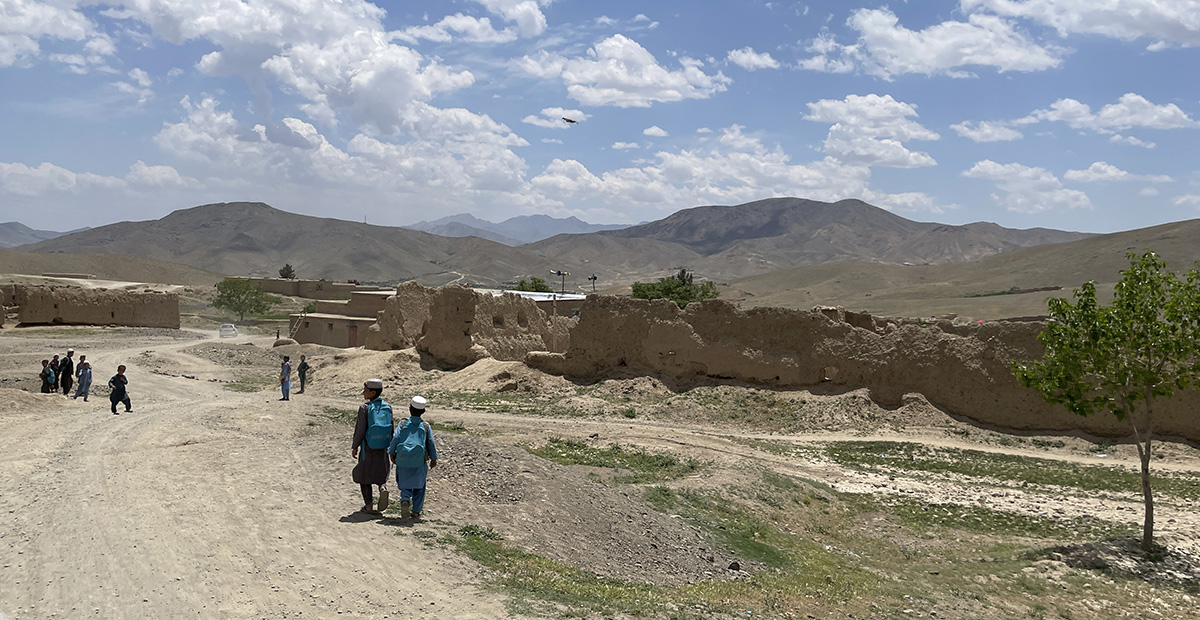
Afghanistan in 2026 presents a paradox. The macro-economy has stabilised, but this conceals a deepening human crisis. Approximately 22 million people – close to half the population – require humanitarian assistance. Around 17 million face acute food insecurity. Child malnutrition is rising. Female labour force participation has collapsed to an estimated 5–6 percent. Per capita incomes are flat or declining.
The international response has contracted sharply. Aid once equalled nearly 40 percent of Afghanistan’s GDP; today effective inflows are likely below half that. The US suspended roughly $1.7 billion in aid during 2025. WFP funding fell by approximately a third. The 2026 humanitarian appeal stands at $1.7 billion – lower than 2025 – and in 2025 little more than 40 percent of it was met. Major bilateral actors, including Sweden and Germany, have moved towards strict non-engagement. The gap between need and response is widening.
Politically unsure as to how to respond in 2021the international system deployed its default response: humanitarian aid expanded to humanitarian plus. This is the wrong model. Humanitarian assistance was designed for acute emergencies, not to sustain a society of forty million people through a multi-decade political crisis and even as aid structures have developed, assistance remains marketplace of short-cycle interventions driven by donor preferences and NGO competition rather than coherent analysis of what Afghan society needs.
Wrong question
The question at the centre of all engagement debates is whether you can engage without legitimising. The short answer is: not really. But this is the wrong question. The right question is whether the distinctions routinely made elsewhere – between recognising a government politically and working with its administrative structures operationally – can and should be applied to Afghanistan. The international community makes these distinctions with numerous governments whose legitimacy is contested or whose human rights records are troubling. The refusal to apply the same logic to Afghanistan is not consistency; it is selective risk aversion whose consequences fall on Afghan civilians, not the Taliban.
In my own negotiations with the Taliban – through the Doha Political Commission from 2012 onwards – what was being discussed was never political legitimacy. It was access, IHL compliance, and the arrangements required to keep health and education services functioning in areas under Taliban influence. When cash assistance was threatened with Taliban taxation, the Commission ruled it exempt and enforced that ruling through its own structures. These achievements came from sustained, principled engagement focused on service delivery – not from disengagement dressed up as principle.
The legitimacy trap has real costs. Humanitarian assistance has been stretched beyond its scope. Bilateral donors have retreated from development cooperation at precisely the moment when the structural gap is most dangerous. NGOs, under divergent donor instructions and legal constraints, have been unable to act collectively, negotiating individually with the Taliban and losing leverage. The Taliban have consolidated their position by default.
Moral argument
There is also a moral argument that cannot be avoided. Basic needs require systems of support that are the responsibility of the state. In Afghanistan those systems continue to exist – health structures operate, schools function in many areas, agricultural services reach farmers. Refusing engagement does not insulate Afghan civilians from Taliban governance. It withdraws resources and oversight from the systems those civilians depend on while leaving the political reality unchanged. That is a choice with consequences borne disproportionately by the Afghan population.
What is required is clearer distinctions between different functions of engagement. Humanitarian engagement – securing access, protecting aid workers, ensuring life-saving assistance under IHL – must be preserved but kept to its proper scope. Service delivery engagement – operational interaction with Taliban administrative structures in health, education, and agriculture – is a distinct function that does not imply political endorsement. It is engagement with the Afghan state in its current form, and avoiding it reduces rather than removes Taliban influence. Political engagement – legitimacy, governance, international recognition – belongs to diplomatic actors and must not constrain the other two functions.
The Taliban are not a monolith. Pragmatism varies by sector, province, and authority level. Agriculture and health offer more space than education. District dynamics often differ markedly from central directives. A coherent strategy must exploit this differentiation.
Technical engagement
In practical terms, donors should allow bounded technical engagement in critical sectors. Immunisation, disease surveillance, and basic public health cannot function without interaction with administrative structures; workable arrangements — including through the Red Crescent — can preserve female health worker roles even under current restrictions. The World Bank’s technical engagement with core institutions, particularly the Ministry of Finance, should be expanded: without basic public financial management, no service system can be sustained. Counter-terrorism carve-outs for development activities need clarification across donor jurisdictions. And financing must rebalance towards multi-year pooled funds rather than annual humanitarian contracts, with UNAMA restructured around monitoring, coordination, and field presence.
The international community does not have the luxury of clean choices in Afghanistan. It has the responsibility to make difficult choices well. Principled pragmatism – sustained, bounded, collective engagement with the systems that keep Afghan people alive – is not a compromise of values. It is what those values require.
MARK BOWDEN
Mark Bowden is a former United Nations Assistant Secretary-General with over two decades of direct engagement in Afghanistan across a range of senior UN roles. He served as Deputy Special Representative of the Secretary-General and UN Resident and Humanitarian Coordinator, with responsibility for humanitarian and development coordination, and support to state-building, the rule of law and peace processes. His experience spans the post-2001 settlement, the period of international military transition, and the evolving UN role following the Taliban’s return to power, alongside broader contributions to UN policy and practice. He has recently been engaged in work on the future mandate and structure of the United Nations Assistance Mission in Afghanistan (UNAMA).