“When midwives learn more, it makes real difference”
Midwives practise maneuvers for safe deliveries in a capacity building programme supported by the Solidarity Committee.
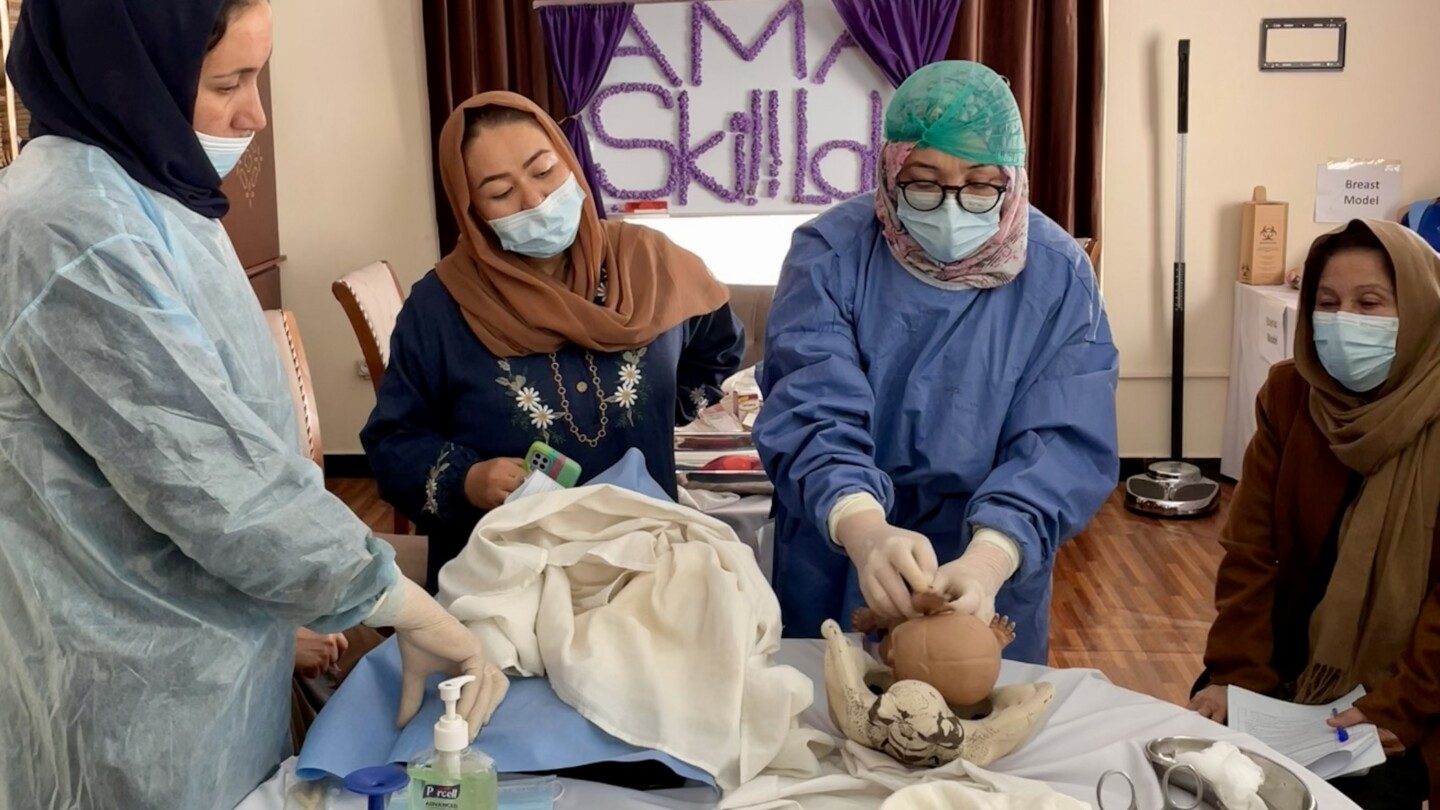
In the training room at the Afghan Midwives Association (AMA) in Kabul, a group of women attentively follow Kamila Qasimi’s demonstration of various childbirth scenarios. She first demonstrates a normal delivery in which the baby’s head emerges first, carefully going through all the steps the midwives must remember. Majabin Jalal acts as her assistant during the demonstration and listens to the baby’s heartbeat. Kamila Qasimi repeatedly reminds the midwives to communicate each step to the mother and ensure that she feels comfortable. A training mannequin with an umbilical cord and placenta is used for the simulation, which concludes with the newborn being placed skin-to-skin on the mother’s abdomen.
Next, they move on to more complex and high-risk scenarios—so-called breech births. Kamila Qasimi, who has worked as a midwife for 21 years, first demonstrates the maneuver to perform when the baby is positioned buttocks first. Finally, she addresses the most complicated situation—when the baby’s arms are extended upward, causing the shoulders and head to become stuck.
Experienced mentors
These training sessions are part of a ten-day course within AMA’s capacity development programme, supported by the Solidarity Committee. All participants are experienced midwives who also serve as mentors to others. Kamila Qasimi emphasises that everyone needs to refresh their knowledge.
“It’s important to practice, practice, and practice. An essential skill is knowing how to prevent the head from becoming trapped during a breech delivery. Every midwife must learn this, otherwise both the mother and the baby are at risk. Sometimes a cut is made to enlarge the opening when the baby is being born, but this can involve risks such as infection, bleeding, and tearing for the mother,” says Kamila Qasimi.
When Majabin Jalal worked as the sole midwife in a remote rural area, she experienced a similar situation. It was winter, with two metres of snow, and a family arrived at her clinic carrying a woman lying on a bed. The woman had begun labour at home without assistance from any medically trained professional, and the baby’s body and legs had already come out. Majabin Jalal recalls struggling for a long time with various maneuvers to finally deliver the head—but it was too late to save the baby, who was already dead upon arrival at the clinic.
“It will save lives”
Majabin Jalal has worked as a midwife for ten years and estimates that she has assisted more than 1,000 births. Even so, she feels she learned a lot during Kamila Qasimi’s demonstration, which was largely based on the World Health Organisation’s updated guidelines. As chief midwife at a larger clinic in Logar province, she will pass this knowledge on to 24 midwives. She particularly appreciates the opportunity to practice hands-on techniques for breech deliveries.
“All midwives need to have these skills and learn more about complications that can arise during pregnancy, childbirth, and postpartum. It will save lives of mothers and newborns,” says Majabin Jalal.
Two of the midwives participating in the course are mentors for the midwives staffing the ten clinics in Wardak province that are supported by the Solidarity Committee. Kamila Qasimi says the training is especially important for them, so they can pass on the knowledge.
“In such remote areas there are no gynecologists or doctors, only a midwife. When midwives learn more, makes real difference,” she says.