A midwife free to manage the entire continuum of care
In a small building next to her home in Wardak province, the midwife Karima receives women from the surrounding villages.
One of them is Nawida, who is six months pregnant. She has two children but has also lost two shortly after birth due to RhD immunisation, in which the mother’s antibodies attack the fetus’s red blood cells. Therefore, Karima has referred her to the hospital for blood tests, something that was not done in time during the previous pregnancies.
Now she has come to check how the fetus is moving. Karima feels Nawida’s stomach and listens to the fetal heartbeat. It sounds like it should. But Karima notes that Nawida is dehydrated and needs to drink more.
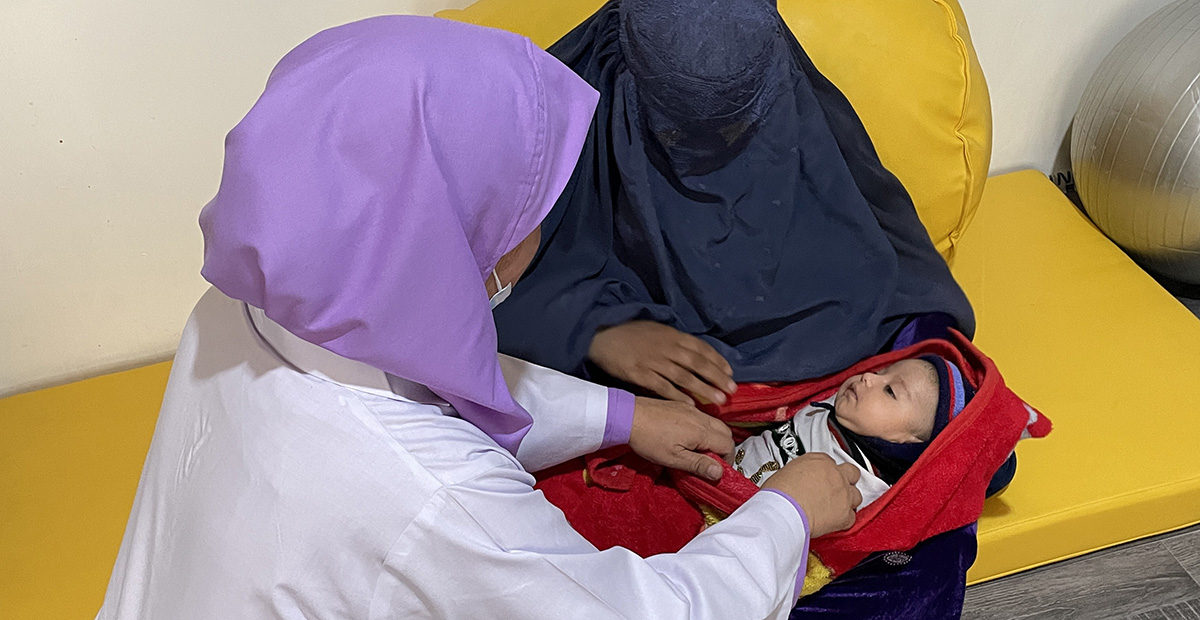
The next patient, Rahima, comes in with a baby wrapped in a blanket. She sits down comfortably on the yellow mattress on the floor. It was here that Karima delivered her son Anzala one and a half months ago. Rahima already had five children—two born at home and three at a hospital in Kabul. At the hospital she did not feel comfortable. There were many patients, and she felt the doctors treated her roughly. She had attended check-ups with Karima and everything looked good. Therefore, she was allowed to give birth at the clinic, even though that should only happen in exceptional cases. She could choose between a birthing chair, an examination bed, or the mattress, and she felt the floor was the most natural.
“Felt at home”
“I felt at home. All the medicine was available, and I had a midwife who took very good care of me,” she says happily.
Now she is breastfeeding Anzala but has difficulty producing enough milk. Karima shows her how to hold the baby’s head so he can feed more effectively.
The next patient is not in nearly as good a mood as Rahima. Rahm Bibi is thin and hides her body in a large green shawl. She says she is 17, but Karima thinks she is several years younger. She has a baby at home whom she tries to breastfeed, but her milk is not enough. It is probably because Rahm Bibi herself is not getting enough nutrition. Her husband is a farmer and earns only 3,000 AFS per month. When Karima made a home visit, Rahm Bibi “Bibi” had not eaten for two days. Now she has come to Karima to get a contraceptive injection and also receives vitamin tablets to take home.
Before Karima came to the village of Taitamor, she worked at a hospital in Kabul.
“I met women from rural areas and they had many problems. When this clinic was going to open, I offered my services, and now I have moved here with my family. I am very proud to work here and I love my clinic,” she says.
Feels free
Being the only midwife at the clinic, with full responsibility for the care provided, does not scare her—quite the opposite.
“Here I feel free. At the hospital I was hardly allowed to do my job; the doctors mostly used me to fetch equipment and medicine. Here I have a real chance to use my skills as a midwife.”
She shows some of the tools she has available when it is time for a delivery. The mother can rock back and forth on a Pilates ball to manage the contractions, and Karima can massage her back with a rolling-pin-like tool to reduce the pain. From a stand hangs a rope that the woman can hold onto for an upright birth instead of lying down.
The clinic is operated by AMA, Afghan Midwives Association, with funding from Solidarity Committee. It is one of ten that SC’s local associations, board, and staff raised money for in a fundraising competition last year. The result exceeded expectations, and SC is looking into the possibilities to expand the project with more clinics.
Read more: