Homeschooling offers a path to independence
Brothers Hamedullah and Shukrullah are both deaf. With Solidarity Committee’s support, they have been homeschooled and learned sign language, and to read and write.
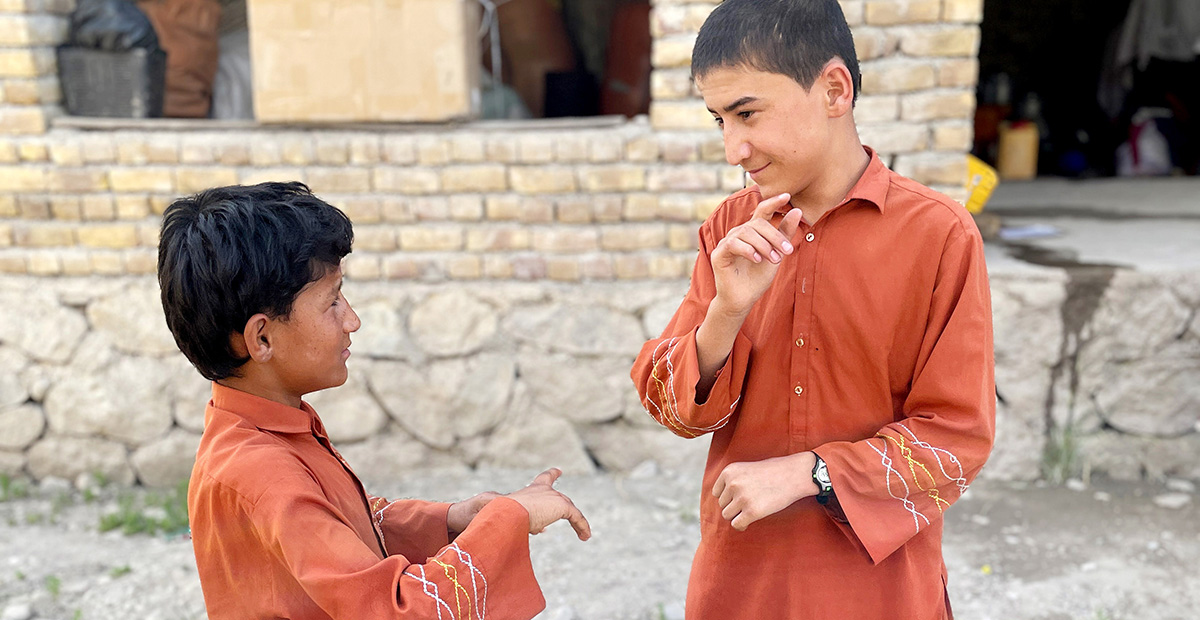
“They are so eager to learn that they fill up their notebooks quickly, we have to buy new ones for them all the time,” says their older sister, Nazia.
She has learned sign language to be able to communicate with her brothers.
The family lives on the outskirts of the city of Taloqan in northern Afghanistan. The children’s father is dead, and it is difficult for the family to make ends meet. In the evenings, the boys shine shoes on the streets. Their older brother sells ice cream and has never had the chance to go to school. Their mother and older sister sometimes sew clothes that they sell.
Hamedullah, 11, and Shukrullah, 9, have been homeschooled for a year. After three years of preparatory education, the goal is for the two brothers to be integrated into a regular school.
Hamedullah says he wants to continue school and become a doctor or teacher.
Writing Braille
He shares his dream of becoming a teacher with Efat, nine years old, who also lives in Taloqan. She is blind and has been homeschooled for the second year. When we visit, she practices writing Braille.
– I want to become an expert in writing Braille and teaching others, she says.
Since starting the lessons, she has also learned to walk with a cane.
In addition to reading and writing skills, homeschooling includes activities to help children become more independent in their everyday lives. For children with more severe disabilities, these are the activities that are focused on, at least at first.
Outside the city of Kunduz, among fields where wheat grows thickly, Hadia lives with her parents and her uncle’s family.
Hadia has a severe intellectual disability and also epilepsy. She can speak a little and understands much more than she can express herself.
– When I first came here, she couldn’t go to the toilet by herself. She can now. I have taught her to eat by herself, comb her hair and cut her nails, says rehabilitation worker Zarmina Abrar. She has been teaching Hadia for two years.
Happy with progress
Hadia’s father, Sher Mohamed, is a farmer. He is grateful for the help his daughter receives and happy with the progress she is making, even when the advancements are small.
– She now greets me and says “salam”, and she calls the children she plays with by their names, he says.
Hadia usually plays with her cousins, and enjoys attending weddings. She especially likes the music, and her hands are red after a henna ceremony.
Mirwais Shaiq, technical senior officer at the Afghan Development Association (ADA), which implements the activities supported by SC, says that homeschooling is not only beneficial for the children.
– For children who cannot perform basic daily tasks, such as eating, getting dressed or using the toilet on their own, rehabilitation workers make home visits to teach them important practical skills. It is very important for the family because it reduces the constant burden of providing the child with that help. The efforts improve the well-being of the entire family and they experience a sense of relief, says Shaiq.
In Afghanistan, it is estimated that about 17 percent of all children live with at least one disability. A large majority of them do not go to school. This is due to, among other things, stigmatisation, lack of understanding of their needs, lack of accessibility and poverty.