Healthcare reaches a critical point as funding declines
Afghanistan’s healthcare system is facing enormous challenges due to drastic cuts in international donor funding. Last year, the Taliban authorities published their first national health policy.
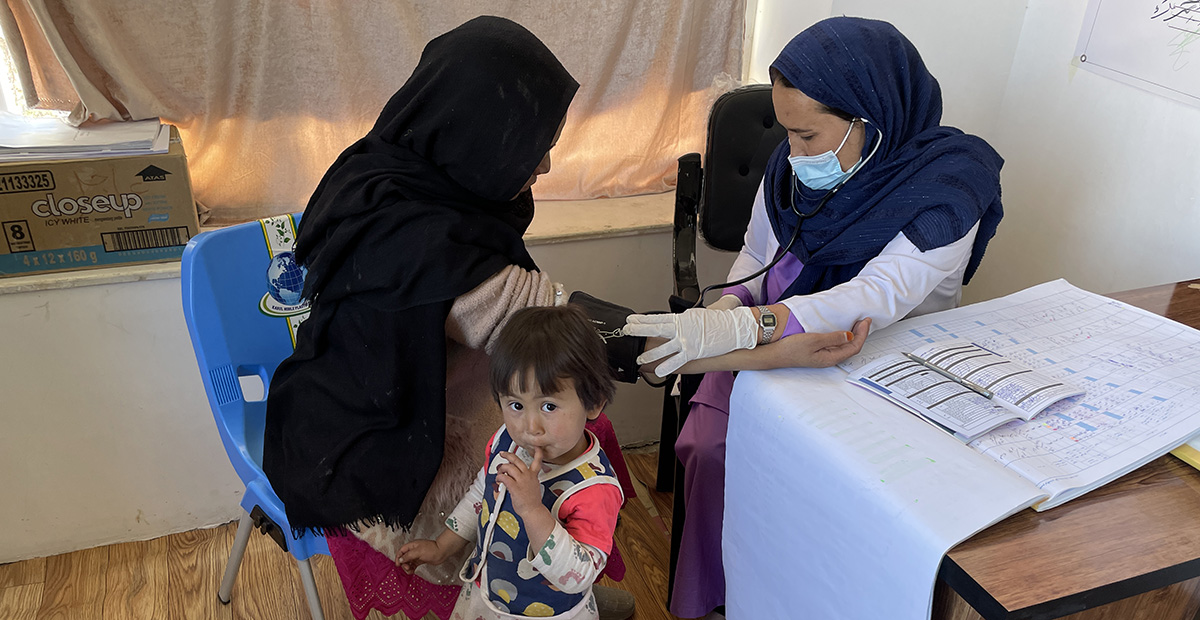
. Despite its shortcomings, many see it as a sign that the de facto government is taking greater responsibility for the health of the population, creating new opportunities for engagement.
Most healthcare in Afghanistan is financed by international donors and delivered through UN agencies, which in turn contract local and international NGOs. The international community operates a parallel healthcare system because the Taliban government is not internationally recognised.
“One word to describe Afghanistan’s healthcare system is fragile,” says Edwin Ceniza Salvador, the World Health Organization’s Representative in Afghanistan.
The Taliban allocated only a very small share of their budget to healthcare – just one percent in 2022. According to the World Health Organization (WHO), that share has increased since then, although exact figures are not yet available.
Even before the dramatic reductions in international aid – particularly from the United States, but also from other donor countries – funding was insufficient to meet healthcare needs. Primary healthcare, which is largely delivered by international and local NGOs, is supposed to be free of charge. Nevertheless, Afghans pay around 75 percent of healthcare costs out of their own pockets, according to Edwin Ceniza Salvador and other experts. Patients often have to pay for medicines, laboratory tests, X-rays, and treatment for conditions not covered by the primary healthcare package. The financial burden is one of the greatest barriers to accessing healthcare, including the cost of transportation.
Nadia Akseer is a global health researcher at Johns Hopkins University in the United States, specialising in Afghanistan and maternal health.
“The health situation in Afghanistan is tragic overall. Large numbers of women and children suffer from malnutrition, and maternal mortality is extremely high and continues to rise,” she says.
Rebuilt 2001–2021
Between 2001 and 2021, Afghanistan’s healthcare system was rebuilt with international funding. Maternal and infant mortality declined significantly from extremely high levels, although they remained among the highest in the world when the Taliban returned to power in 2021.
“That does not mean the system was perfect. There were many challenges: restrictions on women’s mobility, corruption, and the way funding was managed. Donors channelled money through the government, which then contracted NGOs. A great deal of funding was lost along the way, so there were serious problems, but there was also real progress,” says Nadia Akseer.
When the Taliban took power, all support to the Afghan state was suspended. After a few months, the current parallel healthcare system began to emerge. Akseer describes it as a patchwork, lacking any long-term strategy.
In 2025, the United States effectively halted almost all aid to Afghanistan. US funding had accounted for around 40 percent of all healthcare financing. As the largest donor, the United States had also encouraged other countries to contribute. When US assistance was withdrawn, many other donors also began reducing their support. According to World Bank sources cited by Akseer, total aid to Afghanistan may decline by as much as 90 percent by 2027 compared with 2024.
Another major challenge is the shortage of qualified healthcare workers, particularly women. Since December 2024, women have been banned from higher education, including medical education and training for doctors, midwives, nurses, and other healthcare professionals.
“If women cannot receive an education, the situation will become catastrophic. We continue to advocate for these training programmes to reopen,” says Edwin Ceniza Salvador.
Five-year policy
In 2025, the Ministry of Public Health, together with WHO and national health stakeholders, launched a five-year National Health Policy (NHP) for 2025–2030.
“The policy is extremely comprehensive, almost overwhelmingly so. When you see a plan like this, you know it is problematic because it is impossible to do everything. A good health policy focuses on addressing the biggest problems. Since diarrhoea and pneumonia are the leading causes of child mortality in Afghanistan, the policy should focus on preventing those diseases,” says Nadia Akseer.
Afghanistan’s single greatest health challenge, malnutrition, is mentioned only briefly. Akseer believes the policy places too much emphasis on building hospitals and too little on prevention and primary healthcare.
Edwin Ceniza Salvador agrees with some of her criticism but nevertheless sees the policy as an important opportunity.
“I believe this is a very important step. The National Health Policy and the implementation strategy currently being developed hold two parties accountable: the international community and the Afghan government.”
“Interestingly, the policy explicitly highlights the importance of female healthcare workers. That allows us to hold the Taliban accountable for building that capacity while offering our support.”
Although the international community will not finance the Taliban’s healthcare system directly, Salvador believes a compromise must be found that allows Afghan public institutions to strengthen their capacity without implying political recognition.
Dejan Panić is Country Director for Emergency, the Italian humanitarian organisation that has provided healthcare in Afghanistan since 1999. He describes the current situation as extremely serious – and, in his words, “worse than it appears.”
By this he means that the quality of healthcare varies greatly.
“Demand is high, but investment is not. The solution is not simply to build more hospitals. The real challenge is financing the healthcare system itself. Both female and male healthcare workers need further training, clinical skills must improve, and infections need to be prevented.”
Costly journeys
In a 2025 study covering 11 Afghan provinces, Emergency found that three out of four women reported difficulties accessing primary healthcare and maternal health services because of long and costly journeys.
As a result, conditions that could easily have been treated within primary healthcare often developed into serious complications requiring emergency care, creating even greater challenges for patients in terms of transport and costs.
Panić notes that the de facto authorities have shown an interest in investing in healthcare, but believes this will not be enough.
“It is unrealistic to believe that the government alone can finance the healthcare system. Donors should not want Afghanistan’s healthcare system to collapse into catastrophe.”
Having spent many years in Afghanistan, Panić says his work is driven by his faith in humanity.
“There is still compassion. I see the goodwill of the Afghan people. There are highly skilled professionals who give everything they have every day to provide quality healthcare to anyone who needs it.”
EVA KELLSTRÖM FROSTE
Read more: