The returnees are starting from scratch – and worry about the children’s future
They are starting from scratch and worrying about their children’s future, especially their daughters, who are not allowed to attend school.
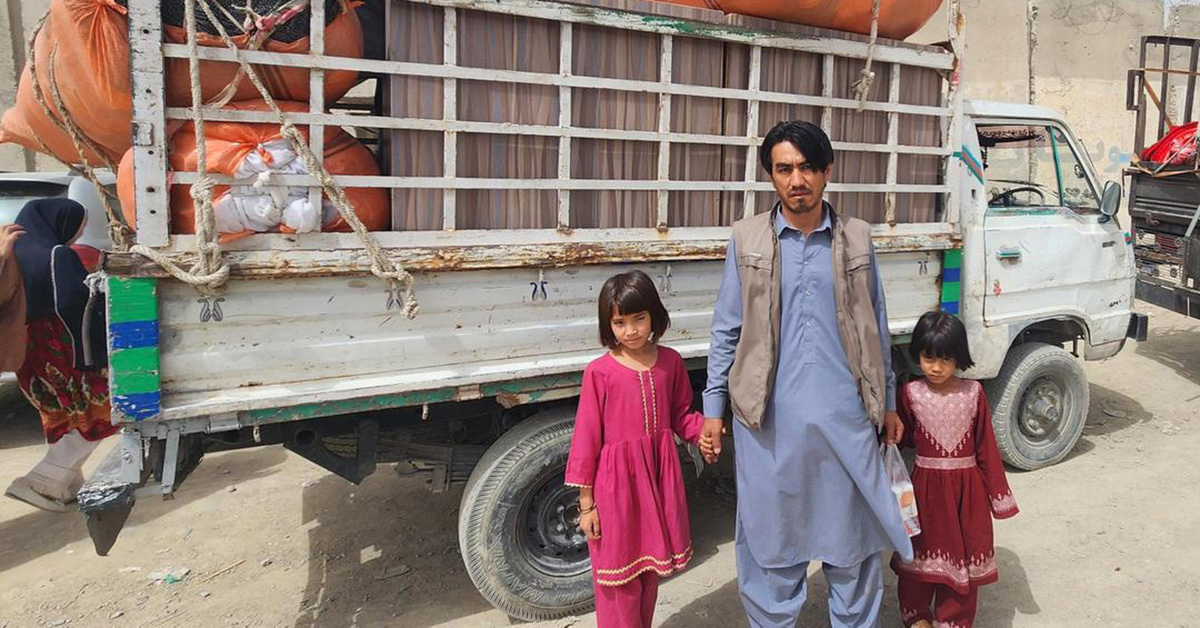
In Kandahar, near the border with Pakistan, a new life marked by deep uncertainty is beginning for Afghans who have been forced to leave Pakistan.
Abdul Majid had lived in Pakistan for 48 years when he was forced to return to Afghanistan due to harassment. All five of his children were born in Pakistan. He ran a small business in Pashtoon Abad and was able to provide for his family. They had a good life, he says.
Now the family lives in Kandahar, renting a small two-room house.
“How am I supposed to take care of my children in a country where unemployment and poverty have increased so much?”
His daughter was engaged in Pakistan, but the family was deported just weeks before the wedding. Abdul Majid has no relatives who can support him. The cash assistance he received from the UN refugee agency UNHCR at the Spin Boldak border crossing lasted for food for a short time.
“I am starting from zero. I have no money to restart my business here. It is very difficult for my family to adapt to the new circumstances.”
“I want my children to study and get an education,” he says.
Widow with seven children
Farida is 38 years old and a widow. When she and her seven children crossed the Spin Boldak border into Kandahar, they had only the clothes they were wearing and very little money. She has no relatives she can turn to for help.
Her husband died in an accident in Pakistan, and she became the sole breadwinner for the family.
“I used to work as a tailor in Pakistan. I earned enough to support myself and my children, and they were able to attend a private school. My daughters in particular worked hard and were eager to study. Life was difficult, but we managed.”
She says Afghans were treated badly. Every day, Pakistani police came to her neighborhood and told Afghans to leave.
“They said there was no place for Afghans anymore. We were deported. I didn’t have enough money to rent a vehicle to transport our belongings, so I had to sell everything to my Pakistani neighbors for half the price. The only thing I managed to bring with me was my children’s clothes.”
Pashtana lived in Quetta, Pakistan. Her husband traveled to Iran to look for work and was never heard from again. She was left alone, without an income, and with a daughter. Out of concern for her future, Pashtana made the difficult decision to leave her home and move to Afghanistan. She now lives with a cousin in Kandahar. Pashtana is a trained tailor and earns a small income by sewing clothes for women. The income barely covers daily expenses.
“There were days when I didn’t know how I would be able to feed my child or keep a roof over our heads,” she recalls.
Things improved slightly when Pashtana received emergency cash assistance. The money helped her pay for food and other household expenses.
“When you have nothing left, even small support can feel like the whole world is reaching out a hand to keep you afloat,” she says.
Asking for support
Those interviewed urge the Afghan authorities to provide support, bank loans, and land to returnees so they can rebuild their lives with dignity. They also call on international organizations to offer assistance in the form of housing, education, healthcare, and opportunities to work.
Liaqat Ali had spent 31 of his 36 years in Pakistan when he was deported along with his wife and four children.
“We were forced to leave with empty pockets. It was especially hard for my wife, whose parents remain in Pakistan,” says Liaqat Ali.
He supported his family by driving a rickshaw. His children attended a good school.
“I lived my entire life there. Now I don’t know where we will go or how I will be able to take care of my children in a country struggling with poverty, unemployment, and lack of education.”
He hopes to travel to Lashkar Gah, the provincial capital of Helmand, and buy a new rickshaw if he can find the money.
At the border, he received a small amount of money from UNHCR, which was enough for food but not for rent or transportation.
Shattered dreams
Liaqat Ali is also deeply concerned about his daughters, as they are not allowed to attend school beyond grade six.
“My two eldest daughters dreamed of becoming doctors, but now their dreams have been shattered. My wife and I are devastated. Our children wanted to study in order to build a good future, but the education system here is broken,” he says.
Faizan is also worried about his children’s future and how they will be able to study. He is considering moving to Kabul, where he has heard there are more opportunities, but he is also aware that the cost of living there is high.
“I came back to my own country, but it doesn’t feel like home. I don’t want my children to grow up under the same harsh conditions that I did—but I don’t know how I can give them a better life.”
Interviews:
COAR, Citizens Organization for Advocacy and Resilience
Edited by:
EVA KELLSTROM FROSTE
More on theme migration: